
Replacing SAP Recipe Management: SAP Recipe Development or SAP IPD?
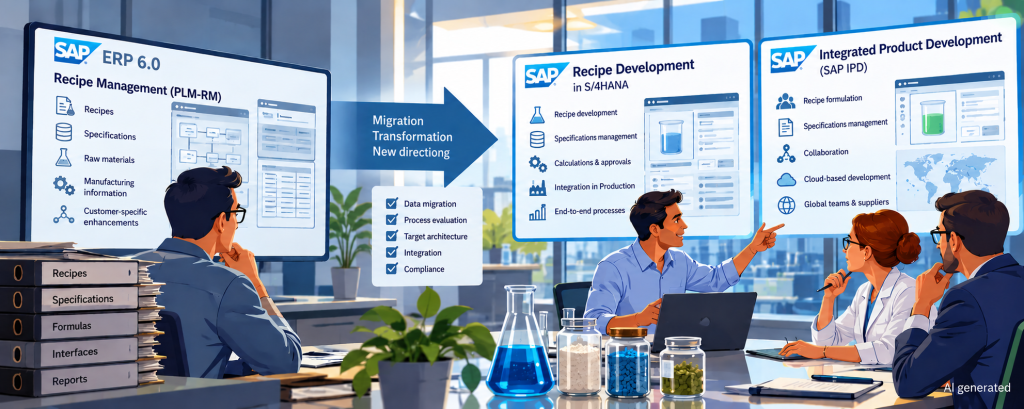

For companies running SAP Recipe Management on SAP ERP 6.0, the date is set: on December 31, 2027, mainstream maintenance ends for SAP ERP 6.0 with enhancement packages 6 to 8. Optional extended maintenance until the end of 2030 buys time, but it costs extra and does not change the direction.
In SAP S/4HANA, classic Recipe Management (PLM-RM) is no longer available in its current form. Process industry companies therefore have to decide where their recipe development will run in the future. The choice is between SAP Recipe Development in SAP S/4HANA and SAP Integrated Product Development (SAP IPD), a SaaS solution on SAP BTP that is connected to SAP S/4HANA. A combination of both is also possible.
What the old system holds
In many companies in the chemical, food and life sciences industries, PLM-RM has been running for years. It holds recipes, formulas and specifications, linked to production, materials management and quality management. Over time, custom enhancements, calculations and interfaces have been added. These enhancements are exactly what makes the switch costly, because they cannot simply be carried over into a new system.
Two target systems for two ways of working
SAP Recipe Development keeps recipe development inside SAP S/4HANA. It manages recipes, formulas and ingredients, uses the specification data, runs calculations and controls approval. Its biggest advantage is the short path to production, materials management and quality management. It suits companies that want to keep development close to the ERP and clean up their processes along the way.
SAP IPD is SAP’s cloud approach to PLM. Specification management, formulation and collaboration with partners run on one platform, and development data is passed to SAP S/4HANA via interfaces. It suits companies with distributed development teams, many sites and close exchange with suppliers. Before starting, however, it must be clear which data is leading in SAP IPD and which in SAP S/4HANA.
We describe in detail how SAP IPD covers specification management, formulation and collaboration in our article How SAP Integrated Product Development Transforms Product Development in the Process Industry.
Two approaches that lead to a dead end
1. Move everything 1:1. Recipes, specifications and custom developments move to the new system unchecked. The result: old modifications and duplicates are “rescued”, and the new system inherits the problems of the old one.
2. Decide by the product slide. The choice falls on the newest solution because it is new, or on the ERP because it is familiar. The result: R&D works around the system, and spreadsheets pop up again next to the new solution.
Our approach in three steps
1. Assessment and fit-gap analysis. We analyze existing processes, data structures, interfaces and enhancements and compare them with SAP Recipe Development and SAP IPD. This shows which functions are missing and which enhancements can be dropped.
2. Target architecture and proof of concept. We define which system leads for which data and choose the migration strategy. A proof of concept with representative recipes and complex recipe hierarchies tests the critical processes before the project scales up.
3. Migration in stages. We clean up and migrate the data, test the integration and train the users. First a pilot area, then the rollout.
Questions to answer before the project
- Which recipes and specifications are still active, and how clean are their links?
- Which PLM-RM functions do you really use, and where does the target system differ?
- Which enhancements and calculations reflect real requirements?
- How will approved recipes reach production and materials management in the future?
- How do you safeguard data integrity and traceability during the migration?
Conclusion
There is no one-size-fits-all recommendation. Companies that develop close to the ERP are well served by SAP Recipe Development. Companies that develop heavily with partners and across many sites should look at SAP IPD, and many end up with a combination. The maintenance deadline is no reason for a rushed migration, but it is a good occasion to clean up your recipe data. Either way, a clean data foundation remains the prerequisite.
SI PRO has supported companies in the chemical, pharmaceutical and food industries with SAP PLM and recipe management for many years.
Planning to move away from SAP Recipe Management? Use our contact form or call us
#SIPRO #SAPPLM #RecipeManagement #RecipeDevelopment #SAPIPD #S4HANA #SAPBTP #ProcessIndustry #Chemicals #Life-Science #FoodAndBeverage #ProductDevelopment
Ähnliche Artikel