

Trade Compliance Is Changing: Why Up-to-Date Sanctions Data Matters in SAP GTS
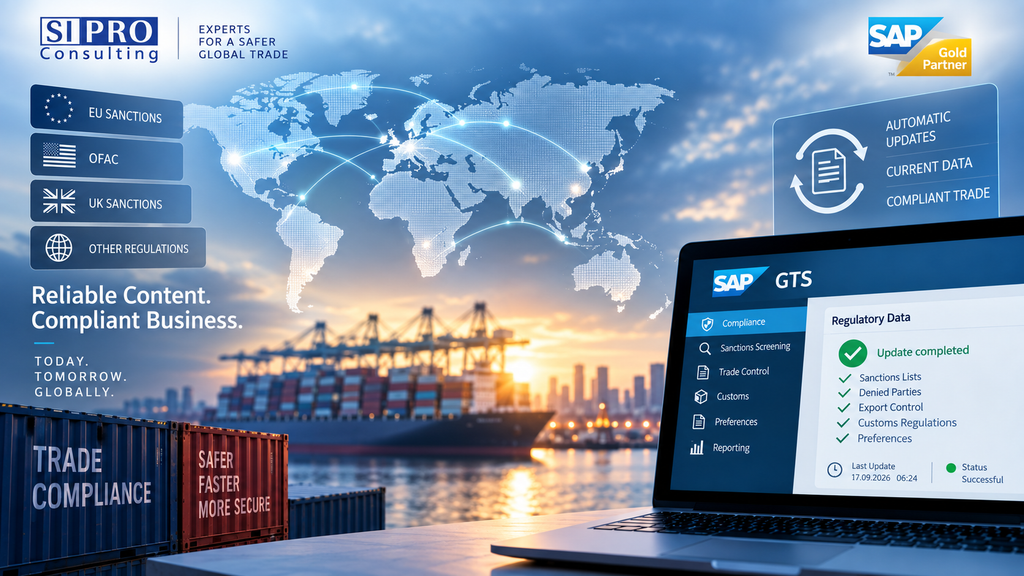

Regulatory requirements in international trade are changing at ever-shorter intervals. New individuals and companies are added to sanctions lists, existing entries are modified, trade restrictions are expanded, and new rules for specific countries, goods, or business scenarios are introduced.
The developments of 2026 clearly highlight this momentum: with its 21st sanctions package against Russia, the European Union adopted further extensive measures in July. This package alone introduced 218 additional listings. At the same time, measures in the financial and crypto sectors were expanded, and additional export restrictions on dual-use goods and technologies were implemented.
Sanctions regimes are also continuously changing on an international scale. The US Office of Foreign Assets Control (OFAC) regularly publishes new designations, amendments, and removals from existing list entries, as well as adjustments to General Licenses.
For internationally operating companies, this creates a central challenge: How can you ensure that regulatory changes are incorporated into your own compliance processes in a timely manner?
Current Sanctions: New Challenges
In recent years, companies have increasingly automated their trade compliance processes. Systems like SAP GTS automatically screen business partners and business transactions for potential compliance risks.
>> But automation alone is not enough.
Even the best screening process can only work with the information available to it. When an individual or organization is newly added to a sanctions list, the timing of the regulatory publication is not the only relevant factor.
What matters most is when this change becomes available in your own system for compliance screening. This is precisely where the currency and timeliness of regulatory data become an essential component of an effective trade compliance management system.
Sanctions List Screening in SAP GTS
Why Up-to-Date Data Is Crucial
The challenge does not lie solely in the volume of new sanction measures. Sanctions data itself is in constant flux. New business partners are listed, existing entries are updated or corrected, and others are removed from lists altogether. Names, addresses, spellings, and other identifying information can change. On top of that, companies must navigate varying regulatory requirements across different jurisdictions.
For globally operating businesses, this means that the relevant dataset is not a static repository that is set up once and only occasionally updated. Trade compliance data is a continuous stream—and that is precisely how companies should treat it.
>> In practice, this often creates a break in the digital process.
When the Process Is Automated, but Data Maintenance Remains Manual
SAP GTS automatically screens business partners and documents—yet the regulatory data required for this screening is still updated via manual processes. New data must be provided, downloaded, reviewed, and subsequently imported into the system. As the frequency of regulatory changes increases, so does the administrative workload. At the same time, a critical operational question arises: What happens between the publication of a regulatory update and its actual availability in SAP GTS? It is precisely this time window that needs to be kept as short and controllable as possible.
Delta Updates Instead of Manual Full Loads
Automating Sanctions List Updates:
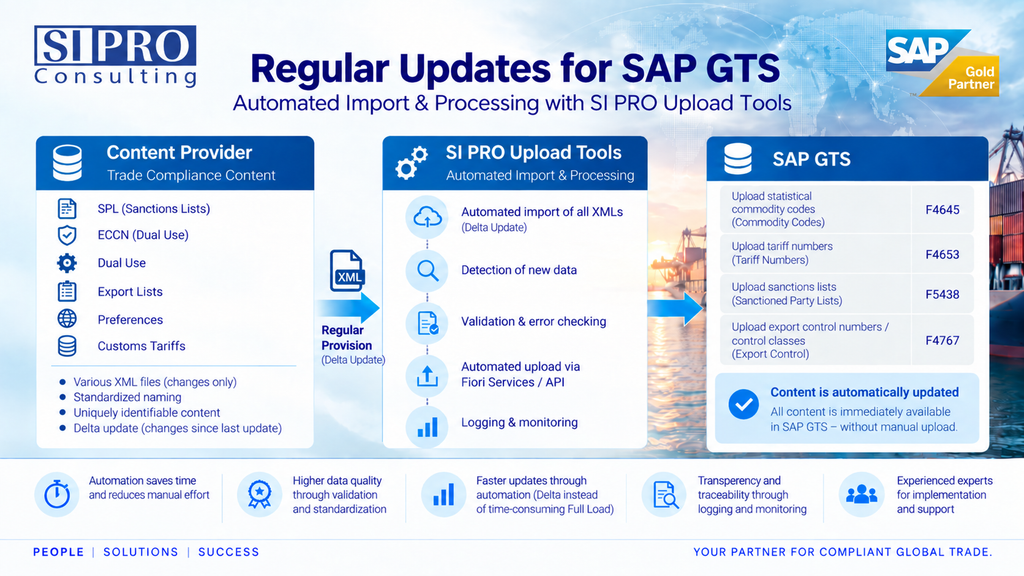
A logical next step is therefore to automate not only the compliance screening itself, but also the supply of regulatory data to SAP GTS. Instead of manually importing entire datasets on a regular basis, changes can be adopted and processed automatically. Delta updates are particularly efficient here: rather than reloading the complete dataset every time, only the specific changes made since the previous data update are processed.
An automated process can combine several steps:
- Provision of new or updated regulatory data
- Automated adoption of changes
- Technical validation of data
- Processing in SAP GTS
- Logging of the import process
- Monitoring of successful and failed processing
>> This allows updates to be carried out in a controlled and repeatable manner.
Securely Integrating Current Compliance Data
For trade compliance, however, speed is not the only factor that counts. Traceability is at least as important. Companies should be able to identify when regulatory data was updated, which dataset version was processed, and whether an update was completed successfully. This is particularly relevant when it needs to be verified later on what data foundation a specific compliance check was performed.
Automation therefore does not simply mean replacing a manual work step with a technical process. It establishes a standardized and documentable data flow between regulatory changes and operational compliance screening.
Not Only Sanctions Lists Are Affected
The same challenge applies to other regulatory content as well. Dual-use goods lists, export control classifications, customs tariff data, and content for preference management also change on a regular basis. This increases the importance of comprehensive content management for SAP GTS.
Specialized content providers, such as our partner Descartes, can deliver regulatory data in a structured format. What matters most thereafter is integrating this data reliably and as automatically as possible into your own SAP GTS processes.
SI PRO supports companies precisely at this interface—from the technical integration of external data sources and automated delta updates to the validation and monitoring of processing within SAP GTS.
Trade Compliance Management
From Current Data to Secure Processes
The velocity of regulatory changes is increasingly becoming a technical challenge for companies. Having a powerful compliance system alone is no longer enough. Equally critical is how quickly and reliably new regulatory information reaches the system.
The decisive question is not merely: Is your SAP GTS screening your business partners? It is also: How up to date is the data you are screening against today?
Automated content updates help shorten the window between a regulatory change and its operational availability in SAP GTS, reduce manual workload, and ensure update processes remain fully traceable. In this way, regulatory content becomes an integrated component of modern trade compliance management.
Conclusion
Up-to-date regulatory data is the foundation of reliable trade compliance. As sanctions and regulatory requirements evolve with increasing speed, automated and traceable updates in SAP GTS become ever more critical. This enables companies to reduce manual effort and consistently perform compliance checks on an up-to-date data foundation.
Would you like to learn how regulatory data and sanctions lists can be automatically integrated into SAP GTS? Get in touch with us. Our SAP GTS experts are here to support you with the design, implementation, and automation of your trade compliance processes.
Want to learn more about how current compliance data can be integrated into SAP GTS? Join our joint webinar with Descartes on 1 October, where we will share practical insights into automated content updates and modern trade compliance processes.
Ähnliche Artikel