
Beyond Accident Management: The Untapped Potential of SAP EHS Incident Management

SAP S/4HANA EHS Workplace Safety Incident Management is often primarily associated with workplace accidents. However, the solution offers much more: it can serve as a common platform for a wide range of EHS, safety, and compliance processes.
Incident Management Is Often Viewed Too Narrowly
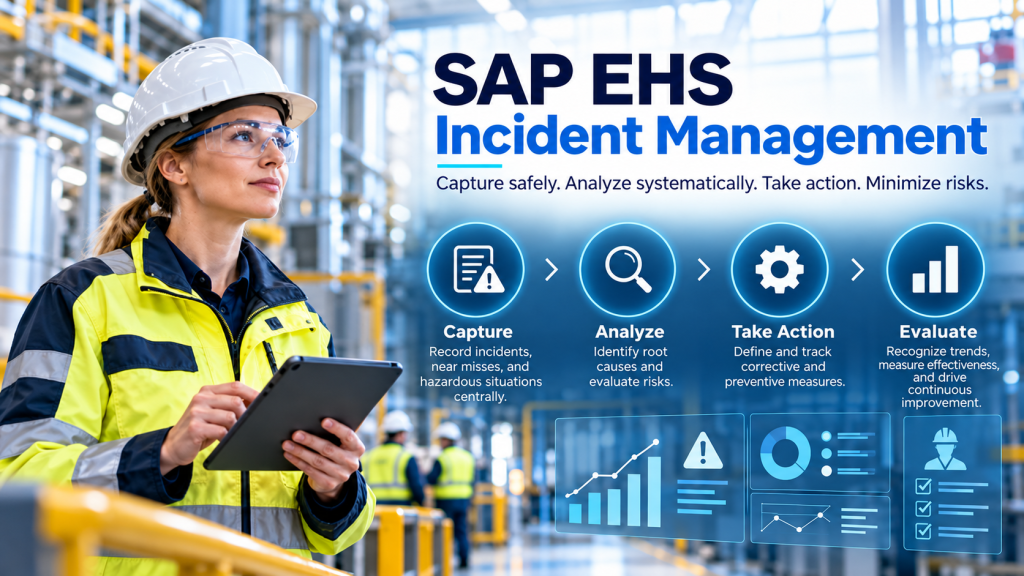
The traditional starting point is the reporting and handling of workplace accidents. However, the underlying process framework is much broader: incidents and findings are recorded, assessed, investigated, assigned to responsible parties, and tracked through corrective actions until closure.
This makes Incident Management suitable for a wide variety of use cases.
These include hazard and near-miss reporting, digital first-aid records, safety inspections, property damage, deviations from legal and regulatory requirements, and environmental incidents. Regulatory notifications and violations, as well as company-specific scenarios such as fire incidents, can also be systematically recorded and managed.
The key question is therefore not simply: How do we record workplace accidents? Instead, it is: Which safety, environmental, and compliance-related events do we want to manage through a consistent, end-to-end process in the future?
Addressing Specific Pain Points
Across our projects, we encounter a wide range of Incident Management use cases – from highly specialized individual processes to comprehensive platform solutions.
Not every company needs to leverage all available capabilities from the beginning. Often, the most effective starting point is a specific challenge: for example, a manual accident reporting process, paper-based first-aid records, missing processes for near-miss reporting, or a standalone solution for safety inspections.
Depending on the requirements, an implementation can therefore focus on optimizing individual processes or bringing multiple use cases together within a shared solution.
Drawing on our experience across different project scenarios, we can consider potential future extensions during the initial solution design. This creates a solution that addresses an immediate business challenge while remaining flexible enough to evolve as requirements grow.
Building a Common Platform Step by Step
At many of our customers, we encounter a combination of legacy applications, Excel-based solutions, and isolated specialized systems – often implemented differently across individual sites.
Incident Management provides an opportunity to gradually consolidate suitable processes within a central system. Shared master data and organizational structures, harmonized processes, centralized reporting, and fewer interfaces can create significant synergies.
Not every existing system can or should be replaced. However, where processes are functionally aligned, an individual use case can gradually evolve into a common EHS and compliance platform – without requiring a large-scale, big-bang implementation.
When used effectively, Incident Management can evolve from a targeted solution addressing a specific challenge into a shared platform supporting various environmental, health, and safety processes, as well as compliance with legal and internal company requirements.
The appropriate level of implementation and expansion always depends on the organization’s specific needs. This is where experience with different implementation approaches provides particular value – especially when integrating Incident Management with other occupational safety, environmental management, and hazardous substance management systems.
What’s Next?
This article marks the beginning of a series on SAP S/4HANA EHS Workplace Safety Incident Management.
In the upcoming articles, we will take a closer look at individual use cases, processes, integration opportunities, and the tangible business benefits they can deliver.
Stay tuned – next, we will explore the individual application scenarios step by step.
#SAPEHS #IncidentManagement #SAPS4HANA #EHSManagement #BusinessTransformation #WorkplaceSafety #Compliance #SafetyManagement
Ähnliche Artikel