
SAP S/4HANA International Trade for Mid-Sized Businesses in Hamburg: Which Solution Is the Right Fit?


Hamburg is one of Germany’s most important international trade hubs. For many mid-sized companies in the region, imports, exports, customs procedures, and international supply chains are part of everyday business. With our office in the historic Chilehaus building, SI PRO has a local presence and is closely connected to the region’s international trade landscape.
Especially during S/4HANA transformations, one key question arises: Which international trade processes can be handled directly within SAP S/4HANA International Trade, and when do additional solutions or SAP GTS make sense?
SAP S/4HANA International Trade: An Integrated Foundation
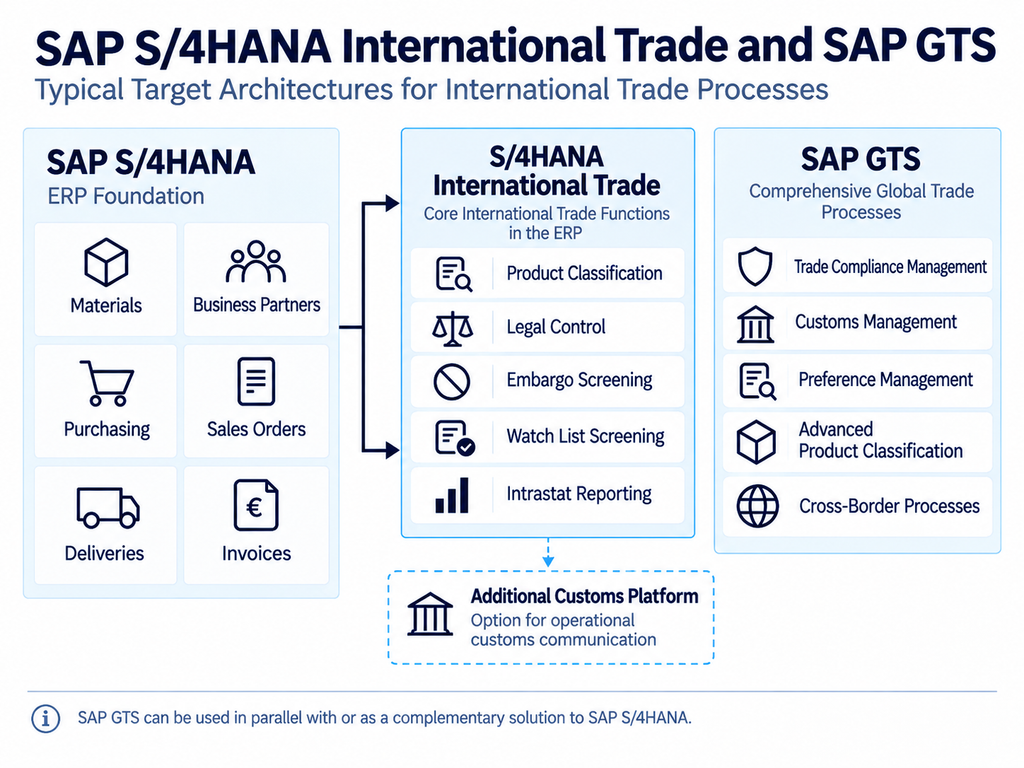
SAP S/4HANA International Trade supports essential international trade and compliance processes directly within the S/4HANA system. These include:
- Product classification
- Legal control and license management
- Embargo screening
- Integration with watch list screening scenarios
- Intrastat reporting
For companies whose requirements primarily focus on these capabilities, International Trade can provide a suitable and closely integrated foundation.
One key advantage is that international trade processes can be directly connected to the relevant purchasing, sales, and master data processes within S/4HANA.
Typical International Trade Challenges for Mid-Sized Businesses in Hamburg
Companies in the Hamburg region often face very different starting conditions. Many have established customs and international trade processes that have evolved over many years, while simultaneously preparing for or undergoing an S/4HANA transformation.
In our projects, we frequently encounter questions such as:
- How can existing international trade processes be smoothly transferred into the new S/4HANA landscape?
- Which product and business partner data must be reliably maintained to ensure accurate classification and compliance?
- Should existing customs software continue to be used and integrated with S/4HANA?
- How can import and export processes be further automated while reducing manual steps and system discontinuities?
- Which functions should be managed centrally in SAP, and which tasks should be handled by specialized customs solutions?
Another common challenge is ensuring transparency in day-to-day operations.
Which customs or compliance status information do sales, purchasing, and logistics teams need directly within S/4HANA?
This is where the integration architecture becomes particularly important. It determines whether users need to work across multiple systems or whether relevant status updates and feedback can be integrated directly into operational SAP processes.
These questions are especially relevant for companies in trading, logistics, and manufacturing – industries that play a major role in Hamburg’s economy.
However, the deciding factor is not simply company size, but the actual complexity of its international trade processes.
For mid-sized businesses in particular, the challenge is often to cover as many requirements as possible within the existing S/4HANA landscape without compromising essential customs and compliance functionality.
SAP International Trade vs. SAP GTS: When Are Additional Capabilities Needed?
Depending on the business model, requirements may extend beyond the standard capabilities of SAP S/4HANA International Trade.
Additional functionality may be required in areas such as:
- Operational customs clearance
- Special customs procedures
- Preference and origin management
SAP Global Trade Services (SAP GTS) is designed for comprehensive, specialized, and cross-border global trade scenarios.
Depending on the target architecture, SAP GTS can be deployed alongside or as a complementary solution to S/4HANA.
In other scenarios, integrating a specialized customs platform may be a more suitable approach. In the Hamburg region, solutions such as DAKOSY may also be relevant.
The right choice depends on the company’s specific processes, existing system landscape, and future requirements.
5 Key Questions for Choosing the Right SAP International Trade Architecture
1. Which international trade functions are actually required?
Are product classification, legal control, license management, embargo screening, and Intrastat reporting sufficient?
2. Is operational customs processing required?
For example, does the company need to create import or export declarations and exchange them electronically with customs authorities?
3. Are special customs procedures necessary?
Examples include transit procedures, customs warehousing, and inward or outward processing.
4. Are preference and origin management processes required?
For example, preferential origin determination or the management of supplier declarations.
5. How complex are your trade compliance requirements?
Are the compliance processes available within the S/4HANA environment sufficient, or are more extensive cross-border and regulatory requirements involved?
SI PRO: Local SAP Expertise in Hamburg
At SI PRO, we look at international trade processes from more than just a technical perspective.
Our experience with SAP GTS, S/4HANA International Trade, and customs integration enables us to work with companies to develop solutions that match their actual business requirements.
In the Hamburg region, we combine SAP expertise with practical project experience in trading, logistics, and manufacturing.
For example, we successfully implemented SAP GTS at Biesterfeld.
This hands-on experience allows us to evaluate different solution approaches and work with our customers to develop a suitable target architecture based on their individual needs.
Conclusion: SAP S/4HANA International Trade or SAP GTS?
SAP S/4HANA International Trade can provide a strong foundation for many companies.
The key is to identify early on which capabilities are required for the specific business scenario, which existing solutions should continue to be used, and how customs and compliance processes should interact in the future.
For mid-sized companies in the Hamburg region, a structured assessment of the existing process and system landscape is therefore particularly valuable.
This helps establish a solution that meets today’s requirements while providing flexibility for the future development of international trade processes.
Let’s Discuss Your International Trade Requirements in Person
If you currently have questions about SAP S/4HANA International Trade, customs integration, or SAP GTS, we would be happy to visit you at your location in Hamburg.
Together, we can discuss your requirements and identify the solution that best fits your business.
Ähnliche Artikel