
How SAP Integrated Product Development Transforms Product Development in the Process Industry

The process industry faces the constant challenge of developing new products faster, safer, and more efficiently. At the same time, demands regarding regulatory compliance, sustainability, data quality, and global marketability continue to rise. For companies in the chemical, pharmaceutical, life sciences, cosmetics, food, and consumer goods sectors, integrated product data management is becoming increasingly essential. This is precisely where SAP Integrated Product Development (SAP IPD), a Software-as-a-Service (SaaS) solution in the Public Cloud, comes into play.
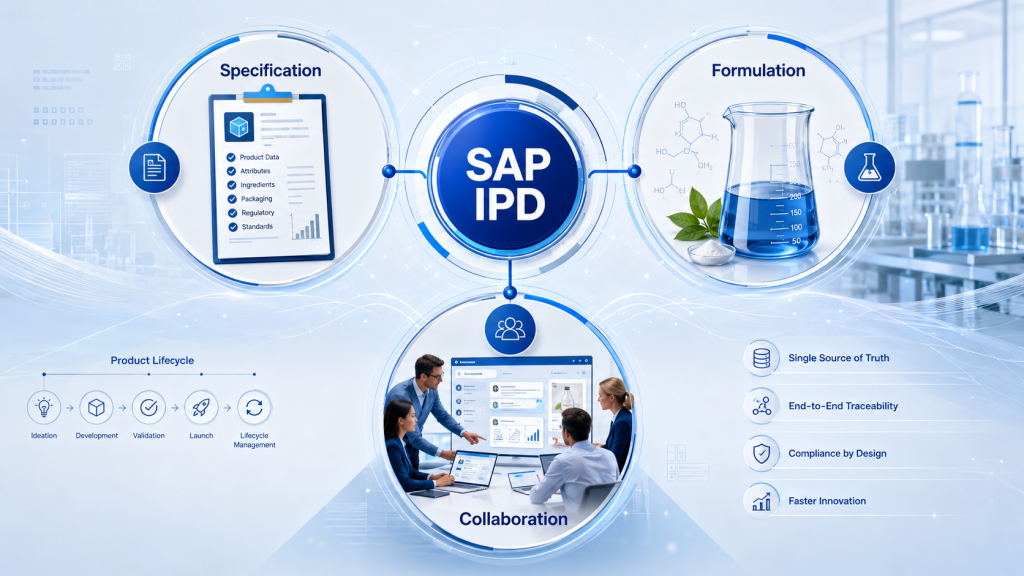
SAP IPD helps companies digitally connect product development, specification management, formulation, and cross-company collaboration. Key focus areas include Specification Management, Formulation, and Collaboration. Together, they form the foundation for making product information and R&D processes structured, traceable, and usable across departmental boundaries and partner networks.
SAP IPD Specification Management: The Core Data Foundation
Specifications describe products, raw materials, intermediates, or packaging as structured data objects. This includes properties, target and limit values, quality characteristics, regulatory information, packaging requirements, and market-specific guidelines. The goal is a central, reliable data foundation (“Single Source of Truth”) that Research & Development, Quality Assurance, Procurement, Production, and Compliance can access together.
This transparency is critical in the process industry. A change to a single raw material or ingredient can impact formulations, costs, availability, labeling, hazardous substance evaluations, allergen declarations, sustainability metrics, or manufacturability. Modern specification management must make these dependencies visible and manageable.
SAP IPD Collaboration: Seamless Integration of Partners and Suppliers
A critical success factor in product development is the secure integration of external stakeholders, such as raw material suppliers, contract manufacturers, or testing laboratories. Through SAP IPD Collaboration capabilities, companies can securely exchange both structured product data (such as specifications, materials, or bills of materials) and unstructured data (such as documents, specification sheets, or images).
With defined workflows, task management, and role-based access controls, collaboration with suppliers is accelerated while minimizing potential errors. Instead of manually exchanging product data via email or PDFs, internal teams and external partners work together on a single, secure collaboration platform.
SAP IPD Formulation: Integrated recipe development
The third core module is Formulation. For an integrated recipe development the objective is to combine ingredients, properties, target values, and variants so that a product is technically feasible, cost-effective, and fully compliant. SAP IPD provides features to manage formulas and variants digitally and support data-driven development workflows. As a result, R&D decisions become more traceable, alternatives can be evaluated systematically, and time-to-market is significantly improved.
Integration and Hybrid Scenarios
SAP IPD is continuously expanded by SAP with new usability features and hybrid capabilities. A key highlight is the IPD Specification Collaboration Hybrid Scenario, which connects the cloud-based SAP IPD platform directly with on-premise or private cloud environments such as SAP S/4HANA Specification Management. This enables bidirectional synchronization of specification data, ensuring that core ERP data flows seamlessly into cloud collaboration with suppliers, and feedback is securely routed back.
For enterprise environments with existing SAP PLM, SAP EHS, or SAP S/4HANA landscapes, this is particularly relevant because product data cannot exist in isolation. The key lies in deep integration with established business processes, master data models, compliance structures, and operational workflows.
Artificial Intelligence and Data Quality
AI-driven capabilities are gaining increasing importance. When analyzing and using product data, AI can assist users in finding information faster, detecting data gaps, and guiding them through complex specification, collaboration, and formulation structures. High data quality remains the prerequisite for leveraging these capabilities effectively.
Shaping Digital Product Development with SI PRO
As an experienced SAP consulting company, SI PRO GmbH supports process industry companies with these exact challenges. Leveraging years of domain expertise in SAP PLM, SAP EHS, SAP Product Compliance, and related SAP processes, SI PRO helps companies implement specification management, supplier collaboration, formulation development, and product data processes in a technically robust manner – elevating them to the next level using modern cloud architectures.
Ultimately, SAP IPD offers the opportunity to shape product development into an integrated, data-driven, and collaborative process. However, value is created not just by adopting new software, but through clear data models, strong governance, seamless integration, and a deep understanding of the process industry’s unique demands.
Ähnliche Artikel