
SAP EHS Incident Management: What Really Matters in Projects
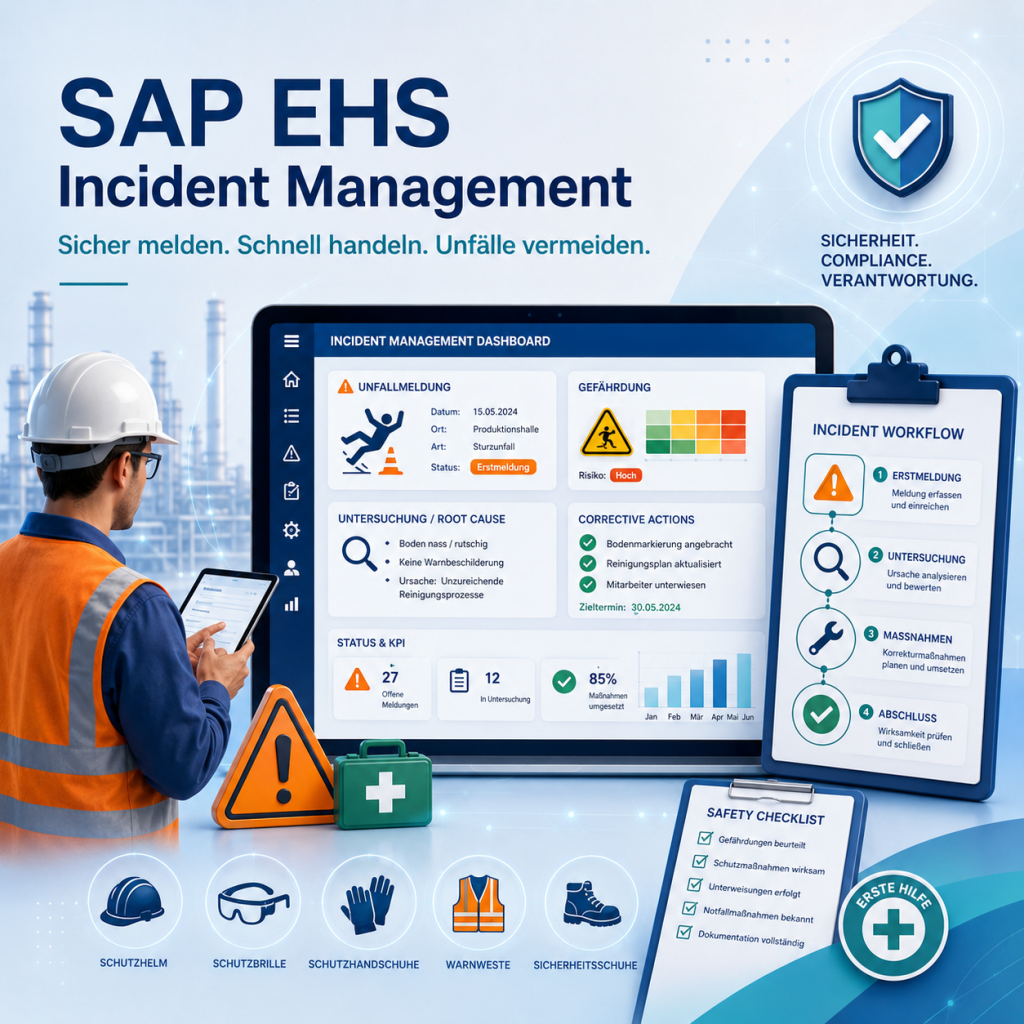

A workplace accident can happen in a matter of seconds. What follows is usually a much more complex process: people need to be informed, causes investigated, corrective actions defined, and deadlines met. Depending on the incident, authorities or accident insurance institutions may also need to be notified.
In many companies, this process has evolved over time and is spread across emails, Excel spreadsheets, paper forms, and different areas of responsibility. This often works surprisingly well for quite some time — until multiple sites, increasing compliance requirements, or more complex reporting processes come into play.
SAP EHS Incident Management can support this process end to end. From a project perspective, however, the real challenge is not simply recording an accident in the system. What matters is creating a process that is easy to use in daily operations while also being robust enough for audits, reporting, and regulatory requirements.
Don’t Start With the System
One of the most important lessons from Incident Management projects is that implementation should not start with screens, fields, and customizing.
The business questions need to be answered first.
What should actually be reported? Who is allowed to record an incident? Who is responsible for the investigation? Who decides on corrective actions? And when is an incident really considered closed?
The distinction between Incident, Near Miss, and Safety Observation also needs to be clearly understood across the organization.
Technically, these categories can be separated very precisely. But that does not help much if different sites classify the same type of event differently.
A common understanding of terminology and processes is therefore one of the most important prerequisites for reliable data.
Reporting Must Be Simple
A good Incident Management solution should not overwhelm the person making the initial report.
Especially for near misses and safety observations, ease of use has a direct impact on whether employees actually use the system.
For an initial report, a small amount of information is often sufficient:
What happened? Where and when did it happen? Who was involved? Is there an immediate hazard?
Detailed assessment, root cause analysis, and classification can then be handled by trained roles.
In my experience, this separation between simple initial reporting and professional follow-up processing is one of the most important factors for user acceptance.
A system may be functionally complete, but if people avoid using it, it will not contribute to a better safety culture.
Don’t Automate Every Exception
SAP offers extensive options for workflow-based notifications, investigations, and corrective actions.
This is also where projects can quickly become overly complex.
Site A wants a different approval flow than site B. Certain incidents require additional stakeholders to be informed, and some departments have developed their own processes over many years.
Technically, much of this can be implemented.
The more important question is:
Is this process variant really necessary — or are we simply automating historically grown differences?
An Incident Management project is therefore often also a process harmonization project.
From my perspective, the goal should be to establish as few robust process variants as possible. Deviations make sense where there are regulatory or genuine business reasons — not simply because one department has always worked differently.
The Real Value Comes From Corrective Actions
At some point, an incident is fully documented. For the safety organization, however, the most important work often starts afterwards.
What was identified as the root cause? Which action was derived from it? Who is responsible? By when must it be completed? And was its effectiveness actually verified?
This last point in particular is often underestimated in practice.
A corrective action with the status “completed” does not automatically mean that the underlying risk has actually been reduced.
A strong Incident Management process therefore creates a transparent link between the event, the root cause, the corrective action, and the effectiveness review.
This does not only improve auditability. More importantly, it ensures that the organization actually learns from incidents.
Regulatory Reporting Is More Than an Interface
For companies in Germany, reporting workplace accidents to the relevant accident insurance institutions is an important part of the overall process.
SAP can provide the required reporting data in a structured way and help avoid duplicate data entry.
However, project experience shows that the technical interface is rarely the biggest challenge.
The key question is whether all required information is available in the system at the right time.
This requires reliable master data, clearly defined responsibilities, and timely completion of missing information.
Regulatory reporting should therefore never be viewed in isolation. Ultimately, it is the result of a functioning upstream Incident Management process.
Reporting Starts With Data Capture
Many companies want better KPIs from day one: accident frequencies, lost-time data, root causes, risk categories, site comparisons, and trends.
That makes sense.
But good reporting does not start in the dashboard.
It starts with data capture.
If root causes are classified differently across the organization, or if some sites consistently report near misses while others hardly do, later KPIs will only be comparable to a limited extent.
This is why the design phase should work backwards from the desired outcome:
What insights do we want to generate later — and which data do we need to capture consistently today in order to get there?
This question often has a greater impact on classifications, mandatory fields, and process design than purely technical requirements.
Integrate Selectively, Not Maximally
Incident Management delivers the greatest value when integrated with other SAP and EHS processes.
Typical examples include employee and organizational data, asset information, cost centers, as well as existing safety and hazardous substance information.
Even so, not every possible integration should be implemented in the first project phase.
From a project perspective, it is often better to stabilize the core process first:
report – investigate – assess – manage actions – close.
Additional integrations can then be introduced where they provide a clear business benefit.
This reduces project complexity and prevents a technically sophisticated architecture from being built while the core process itself is still unstable.
The Most Important Success Factor is the Organization
After many years in SAP and transformation projects, one conclusion is especially clear to me:
Technology is rarely the most critical part of an Incident Management implementation.
What really matters are clear responsibilities, simple reporting channels, and an organization that genuinely wants to learn from incidents.
This is particularly true for Near Misses and Safety Observations.
A serious workplace accident will almost always be reported. A critical observation, however, is only reported if employees feel that their input is taken seriously and does not simply create additional bureaucracy.
This is also where the strategic value of Incident Management becomes visible.
It is not only about documenting events that have already happened. The objective should be to identify risks and patterns early and take action before real harm occurs.
Conclusion
SAP EHS Incident Management is much more than a digital accident reporting form.
A successful implementation combines processes, organization, data, compliance, and technology.
The key question should therefore not be:
How can we reproduce our existing process in SAP as closely as possible?
But rather:
What should a strong future Incident Management process look like — and how can SAP support it effectively?
This is exactly the point where a technical implementation becomes a business transformation project.
Based on my project experience, the best solutions are created when business, IT, and management first agree on a simple and robust target process — and only then decide how this should be implemented using SAP standard functionality and selected extensions.
#SAPEHS #IncidentManagement #SAPS4HANA #EHSManagement #BusinessTransformation #OccupationalSafety #Compliance #SafetyManagement
Ähnliche Artikel